Leadtime Supply Risks and How to Hedge Them — Multi Site Operations
VapeWholesaleHub Leadtime · Leadtime OEM and private label
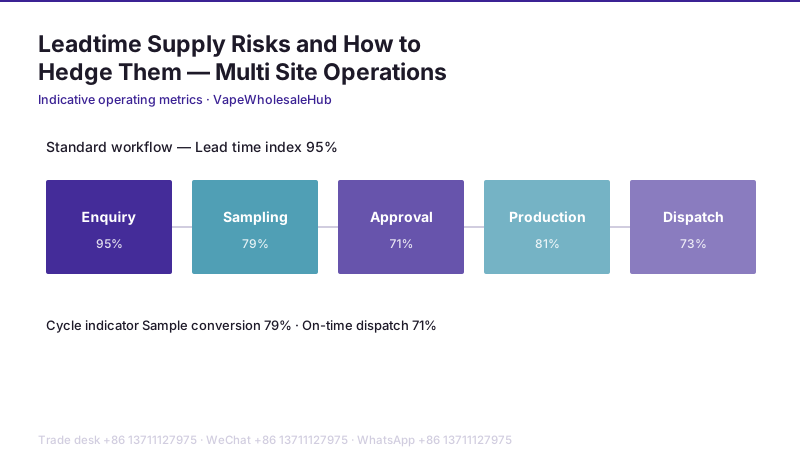
Distributors working with Leadtime rarely lose money on a single bad order. They lose it on the slow leaks: a spec sheet nobody read, a pallet held at customs for nine days, a line that quietly fell out of favour while the reorder was still on the water. This page looks at leadtime Supply Risks and How to Hedge Them — Multi Site Operations from the angle that matters to a buyer, not a brochure.
Technical detail worth understanding
The engineering around leadtime Supply Risks and How to Hedge Them — Multi Site Operations is mostly about managing heat and airflow. Change either and the whole experience moves. Buyers who understand that relationship can read a spec sheet properly and spot the marketing numbers that do not survive contact with a customer.
Technically, leadtime Supply Risks and How to Hedge Them — Multi Site Operations is a set of tolerances rather than a single specification. Coil resistance varies, battery capacity degrades, and perception shifts with device temperature. Designing within those tolerances is what separates a product that works from one that works in the lab.
The commercial side of the decision
Commercially, leadtime Supply Risks and How to Hedge Them — Multi Site Operations rewards buyers who think in turns rather than in unit cost. A slightly higher price on a line that sells through twice as fast is better money than a cheap line that occupies shelf space and working capital for two seasons.
Margin on leadtime Supply Risks and How to Hedge Them — Multi Site Operations is usually set by the structure of the deal, not the sticker. Payment terms, freight responsibility, breakage allowance and return rights all move the real number. We would rather agree a clean structure with a fair price than a low price with vague terms that get argued about later.
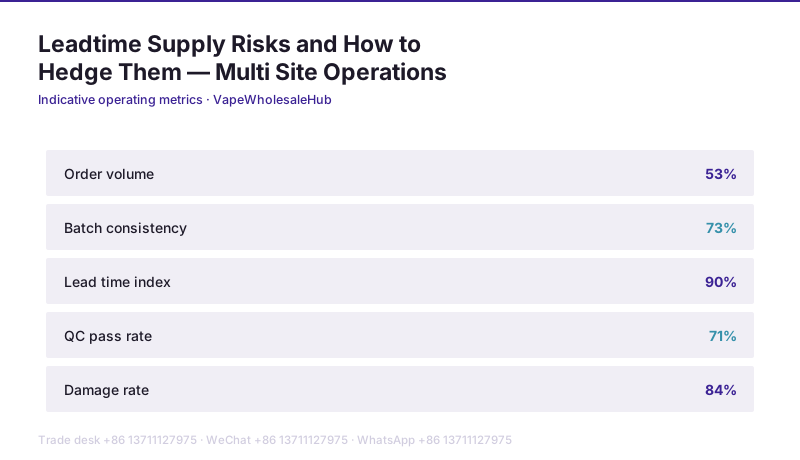
Freight, packaging and landed cost
Packaging is part of logistics, not marketing. Cartons for leadtime Supply Risks and How to Hedge Them — Multi Site Operations need to survive stacking, humidity and a forklift operator having a bad Monday. We specify board grade and pallet pattern before we talk about print finish, because a damaged pallet costs more than any artwork upgrade recovers.
Logistics decides whether leadtime Supply Risks and How to Hedge Them — Multi Site Operations is profitable more often than product quality does. A three day saving on a freight route is worth more per unit than most price negotiations, and it is usually easier to achieve. Mode choice, consolidation and customs pre-clearance are where the margin actually lives.
Where the supply actually comes from
On the sourcing side, leadtime Supply Risks and How to Hedge Them — Multi Site Operations comes down to how much of the chain you can see. A trading desk that only ever talks to a sales rep is buying on faith. We prefer accounts that ask for the factory audit, the mixing records and the batch numbers, because that paperwork is what protects everyone when a shipment is questioned later.
A useful test for leadtime Supply Risks and How to Hedge Them — Multi Site Operations is to ask two suppliers the same uncomfortable question and compare how long the answer takes. Serious operations have the data ready. Everyone else needs to check with someone, and that delay tells you how the next twelve months will feel.
Order structure at a glance
| Item | Standard | Volume | Programme |
|---|---|---|---|
| Typical order unit | Master carton | Pallet | Full container |
| Documentation | COA + SDS | COA + SDS + batch record | Full technical file |
| Lead time | 2-4 working days | 5-10 working days | 15-25 working days |
| Customisation | Label only | Label + closure + bottle | Full OEM / ODM |
| Sampling | Charged, credited on order | Included in development | Multi-round approval |
| Indicative MOQ | 1200 units | 6,000 units | 24,000 units |
| Development window | n/a | 5-8 working days | 5-8 + approval |
Common questions
What happens if goods arrive damaged?
Photograph the cartons before unpacking, keep the packaging, and send the batch code with your claim. We settle legitimate freight damage as a credit or replacement on the following order rather than leaving it open for months.
How long does a bulk order take to arrive?
Stock lines usually leave the warehouse within two to four working days, with transit depending on the mode you choose. Custom development runs on a longer clock: formulation, approval, production and testing before anything ships. We give a written schedule at order confirmation and flag slippage the day we see it.
Do you offer private label or OEM production?
We do. Private label covers artwork, bottle and closure choice on existing formulations. OEM and ODM work goes further into housing, tooling and exclusive development, with confidentiality agreements in place before any formulation detail is shared.
Related reading
- Leadtime: Preparing for a Category Review — Scaling Up
- Reducing Damage Rates on Leadtime Shipments — Retail Chain Focus
- Negotiating Leadtime Terms With Overseas Factories — Trade Buyer Briefing
- Setting Service Levels for Leadtime Accounts — Trade Buyer Briefing
- Leadtime and the Total Landed Cost Question — Contract Supply Guide
- Managing tooling costs Across Leadtime Product Lines — Bulk Order Planning
Talk to the wholesale desk. Specifications, MOQ, stock and freight options for leadtime Supply Risks and How to Hedge Them — Multi Site Operations.
Phone +86 13711127975 · WeChat +86 13711127975 · WhatsApp +86 13711127975