Leadtime and minimum runs in Contract Supply — Retail Chain Focus
VapeWholesaleHub Leadtime · Leadtime OEM and private label
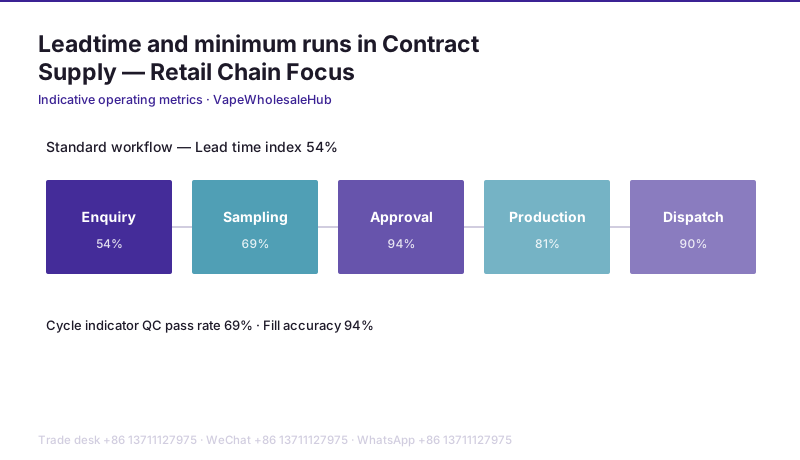
There is a version of leadtime and minimum runs in Contract Supply — Retail Chain Focus that exists in supplier decks, and there is the version that shows up on a warehouse floor at 7am when a shipment is short by two cartons. We spend our time in the second version. Below is what we have learned handling leadtime and minimum runs in Contract Supply — Retail Chain Focus for wholesale accounts.
What quality control looks like in practice
The failure modes in leadtime and minimum runs in Contract Supply — Retail Chain Focus are predictable once you have seen enough of them. Seals that relax in heat, tolerances that drift after a tooling change, inputs that separate in transit. Testing for the known failure modes catches roughly ninety percent of what would otherwise reach a customer.
Quality control on leadtime and minimum runs in Contract Supply — Retail Chain Focus is unglamorous and repetitive, which is exactly why it works. Incoming inspection, fill weight checks, leak testing and a retained sample from every batch. None of this is clever; all of it is cheaper than a recall.
Documentation and regulatory reality
Compliance is where leadtime and minimum runs in Contract Supply — Retail Chain Focus either holds together or quietly falls apart. Regulators are not interested in intent; they want documents that match the physical goods. If the label says one thing and the test report says another, the shipment is the problem, not the paperwork.
The compliance burden around leadtime and minimum runs in Contract Supply — Retail Chain Focus is mostly about being boring and consistent. Keep one version of the truth for every SKU, stamp the revision date, and make sure the file a regulator sees is the same one your warehouse picks from. Most enforcement cases we have watched started with a mismatch between two internal documents.
Where the supply actually comes from
On the sourcing side, leadtime and minimum runs in Contract Supply — Retail Chain Focus comes down to how much of the chain you can see. A trading desk that only ever talks to a sales rep is buying on faith. We prefer accounts that ask for the factory audit, the mixing records and the batch numbers, because that paperwork is what protects everyone when a shipment is questioned later.
Sourcing decisions around leadtime and minimum runs in Contract Supply — Retail Chain Focus are usually made on price and then regretted on consistency. The input changes, the tolerance drifts, and suddenly the line that sold through in March behaves differently in July. Locking the input specification in writing is the cheapest insurance a wholesale buyer can buy.
Technical detail worth understanding
Specification drift is the quiet risk in leadtime and minimum runs in Contract Supply — Retail Chain Focus. A unit approved in January is not necessarily the unit shipped in September unless the change control is tight. We document every revision, and we tell accounts before the change rather than after someone notices.
Technically, leadtime and minimum runs in Contract Supply — Retail Chain Focus is a set of tolerances rather than a single specification. Coil resistance varies, battery capacity degrades, and perception shifts with device temperature. Designing within those tolerances is what separates a product that works from one that works in the lab.
Order structure at a glance
| Item | Standard | Volume | Programme |
|---|---|---|---|
| Typical order unit | Master carton | Pallet | Full container |
| Documentation | COA + SDS | COA + SDS + batch record | Full technical file |
| Lead time | 2-4 working days | 5-10 working days | 15-25 working days |
| Customisation | Label only | Label + closure + bottle | Full OEM / ODM |
| Sampling | Charged, credited on order | Included in development | Multi-round approval |
| Indicative MOQ | 200 units | 1,000 units | 4,000 units |
| Development window | n/a | 5-8 working days | 5-8 + approval |
Common questions
Can you supply documentation for our regulator?
Yes. Technical files, certificates of analysis, safety data sheets and batch records are provided with shipments on request. Tell us which national scheme you operate under at the enquiry stage and we will confirm exactly which documents come as standard.
How long does a bulk order take to arrive?
Stock lines usually leave the warehouse within two to four working days, with transit depending on the mode you choose. Custom development runs on a longer clock: formulation, approval, production and testing before anything ships. We give a written schedule at order confirmation and flag slippage the day we see it.
Do you offer private label or OEM production?
We do. Private label covers artwork, bottle and closure choice on existing formulations. OEM and ODM work goes further into housing, tooling and exclusive development, with confidentiality agreements in place before any formulation detail is shared.
Related reading
- Leadtime Vape Supply Notes 958
- Leadtime and mould ownership: Notes From the Trade Desk — New Account Setup
- Leadtime: Dealing With Supply Interruptions — Multi Site Operations
- Leadtime and production slots in Contract Supply — Regional Depot Guide
- Leadtime Vape Supply Notes 1219
- Leadtime and artwork approval: A Cost Perspective — Regional Depot Guide
Talk to the wholesale desk. Specifications, MOQ, stock and freight options for leadtime and minimum runs in Contract Supply — Retail Chain Focus.
Phone +86 13711127975 · WeChat +86 13711127975 · WhatsApp +86 13711127975